Jewelry Wire Gauge Chart: AWG to mm, and What Each Gauge Is For
Published
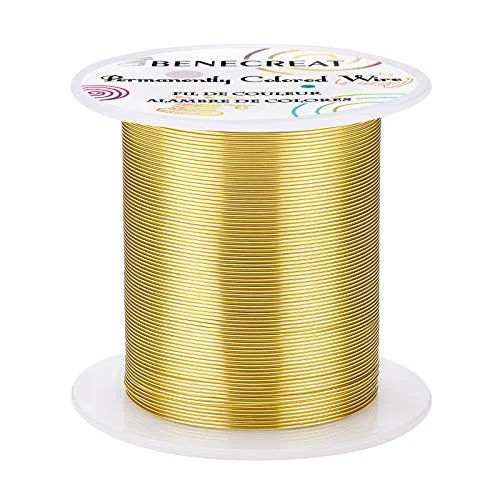
Jewelry wire gauge runs backwards: the lower the number, the thicker the wire. Twenty to 22 gauge (0.81 to 0.64 mm) handles most wrapping and earwires, 16 to 18 builds frames and clasps, and 24 to 28 weaves and coils. The chart below converts every gauge to millimeters and inches.
Most gauge charts online stop at the conversion. This one adds what each size is for, which hardness to buy it in, how to measure the wire already in your drawer, and the one mismatch between American and British gauges that quietly ruins orders.
Jewelry Wire Gauge Chart: AWG to Millimeters and Inches
Diameters follow the American Wire Gauge standard (ASTM B258), rounded to two decimals. The “best for” column is the consensus across jewelry-wire references; the last column shows where a BENECREAT wire in that gauge lives in our jewelry wire range.
| Gauge (AWG) | mm | inches | Best for | BENECREAT wire |
|---|---|---|---|---|
| 10 | 2.59 | 0.102 | Forged pieces, stiff bangles, sculpture armatures | 10-gauge aluminum |
| 12 | 2.05 | 0.081 | Chokers, stiff bracelets, wire-sculpted rings, bold jump rings | 12-gauge aluminum, 12-gauge brass |
| 14 | 1.63 | 0.064 | Cuffs, neckpieces, structural clasps, chunky jump rings | |
| 16 | 1.29 | 0.051 | Neck wires, freeform rings, bracelet bases, heavy-duty clasps | |
| 17 | 1.15 | 0.045 | A half-step between 16 and 18 for frames that need a touch more body | 17-gauge aluminum |
| 18 | 1.02 | 0.040 | Clasps, hooks, base wire under weaving, the most popular jump-ring size | 18-gauge gradient aluminum |
| 20 | 0.81 | 0.032 | The all-round size: sculpted wirework, standard earwires, head pins, light clasps | 20-gauge gold-plated copper |
| 21 | 0.72 | 0.028 | Prong settings and earwires that need extra strength | |
| 22 | 0.64 | 0.025 | Fits most beads: wrapped links, bracelets, pendants, small jump rings | 22-gauge tarnish-resistant copper |
| 24 | 0.51 | 0.020 | Small-hole beads and pearls, wrapped briolettes, frames for small cabochons | |
| 26 | 0.41 | 0.016 | Coiling around heavier wire, weaving, knitting, fine pearls | 26-gauge flat copper, 1 mm wide |
| 28 | 0.32 | 0.013 | Wire crochet and weaving, seed beads, delicate coils | 28-gauge variant of the gold-plated copper spool |
| 30 | 0.25 | 0.010 | Very fine weaving and lashing; breaks if kinked | |
| 32 | 0.20 | 0.008 | Hair-fine weaving; as flat wire, bezel strips for stone wrapping | 32-gauge flat copper, 3 mm wide |
Two shortcuts make the whole table easier to hold in your head: every six gauges the diameter doubles, so 18 gauge (1 mm) is exactly half the thickness of 12 gauge (2 mm), and 1 mm is close enough to 18 gauge that you can use it as a mental anchor.
Why Do Wire Gauge Numbers Run Backwards?
Gauge numbers come from the old wire-drawing trade. Wire was made by pulling rod through a series of progressively smaller dies, and the gauge recorded how many draws it took: more passes, thinner wire, higher number. The American Wire Gauge standardized that sequence into a formula in which each step shrinks the diameter by about 11 percent, which is why the scale is logarithmic rather than linear. Three steps halve the cross-sectional area, six steps halve the diameter, and ten steps cut the weight per foot by roughly a factor of ten.
That last point matters at the checkout. A 100-foot spool of 12 gauge holds about ten times the metal of a 100-foot spool of 22 gauge, which is why heavy aluminum wire sells by the foot in the hundreds while fine copper sells by the hundreds of feet.
AWG or SWG? The Mismatch That Ruins Orders
Two scales share the same numbers. American Wire Gauge (AWG) governs US listings and nearly all Amazon craft wire. Standard Wire Gauge (SWG) is the British scale, and several long-standing bead suppliers still default to it unless a product says otherwise.
The two agree closely at fine sizes and drift apart as the wire gets heavier:
| Gauge | AWG mm | SWG mm | Gap |
|---|---|---|---|
| 22 | 0.64 | 0.71 | 0.07 mm |
| 20 | 0.81 | 0.91 | 0.10 mm |
| 18 | 1.02 | 1.22 | 0.20 mm |
| 16 | 1.29 | 1.63 | 0.34 mm |
| 14 | 1.63 | 2.03 | 0.40 mm |
Read the 16-gauge row twice: SWG 16 is 1.63 mm, which is 14 gauge in AWG. Order “16 gauge” from a supplier working in SWG and the wire arrives two AWG sizes heavier than the jump rings you planned. The fix is simple. When a listing gives millimeters, trust the millimeters and ignore the gauge label. Every BENECREAT wire states its diameter in millimeters next to the gauge, so 12 gauge reads 2 mm, 18 gauge reads 1 mm, and 22 gauge reads 0.6 mm.
Which Gauge for Which Project?
The chart’s “best for” column compresses a lot of experience into a few words. Here is the longer version, by band.
10 to 14 gauge: structure. This is bangle, cuff, and neckpiece territory, and at 10 gauge it is forging territory. Sterling and copper at these sizes fight back, which is why beginners struggle with them. Aluminum changes the math: our 10-gauge and 12-gauge aluminum wires are solid, soft, and shapeable by hand, so a 2 to 2.5 mm armature or bangle base is a five-minute job rather than a workout, at a fraction of the weight of copper.
16 to 18 gauge: frames, clasps, and jump rings. Sixteen gauge makes neck wires, bracelet bases, and heavy clasps. Eighteen gauge is the most-used jump-ring size and the standard base wire under a 26- or 28-gauge weave; it also makes hooks and larger clasps. Seventeen gauge is the quiet in-between, useful when 18 flexes too much on a frame and 16 looks clumsy.
20 to 22 gauge: the working range. If you buy one spool, buy it here. Twenty gauge is the size most often recommended for sculpted and jig wirework, standard earwires, head pins, and lightweight clasps. Twenty-two gauge fits through most crystal and stone beads, so it is the default for wrapped links, rosary chain, bracelets, and pendants, and it makes small jump rings and hooks. The first spool most wire-wrappers finish is a 22-gauge one; ours comes in tarnish-resistant light gold on a 164-foot spool, enough for a season of practice.
24 to 28 gauge: fine wrapping and weaving. Twenty-four gauge threads small-hole beads and pearls and wraps briolettes. Twenty-six gauge coils around heavier frame wire and is the classic weaving gauge. Twenty-eight gauge is barely wider than a hair, tangles if you let it, and is what wire crochet and seed-bead weaving are built on.
30 to 32 gauge: specialist. Round wire this fine is for lashing and the finest weaves and snaps if kinked. As flat wire, though, 32 gauge earns a place on every bench, which brings us to a distinction no gauge chart mentions.
Flat and Bezel Wire: Gauge Is Thickness Only
On round wire, gauge and diameter are the same thing. On flat wire, gauge describes the thickness of the strip and the width is a separate number. Our 26-gauge flat copper is 0.4 mm thick and 1 mm wide; the 32-gauge flat copper is 0.2 mm thick and 3 mm wide. Both are pure, unplated copper.
Flat wire exists because round wire meets a stone along a line and a strip meets it along a band. That is why bezel strips and stone-wrapping strips are flat, and why width is the design choice: the 3 mm strip is cut to the classic bezel width and folds over a stone, while the 1 mm strip is a flat binding and decorative wire rather than a bezel wall. Treat the gauge as a stiffness rating and the width as the job.
Hardness: Dead Soft, Half Hard, and Full Hard
Gauge tells you how thick the wire is. Temper tells you how it behaves, and the two interact: 14-gauge half-hard wire is far harder to bend than 22-gauge half hard, so the heavier you go, the softer you usually want to buy.
| Temper | How it feels | Use it for |
|---|---|---|
| Dead soft | Bends by hand into loops, spirals, and free forms | Coiling, weaving, crochet, wrapping, sculpture; hammer it to stiffen |
| Half hard | Drawn once more, holds crisp angles, springs back slightly | Jump rings, prongs, frames, traditional wirework |
| Full hard | Springy and resistant, needs tools and effort | Earwires, pins, hooks, and clasps that take daily stress |
Two facts save frustration. First, every bend hardens wire, so a dead-soft frame that has been shaped and hammered ends up close to half hard on its own; overwork it and it snaps. Second, colored and plated craft wire is sold soft to medium so the coating survives bending, and aluminum is soft by nature, which is exactly why those wires are the easiest to learn on and the wrong choice for a load-bearing clasp.
Jump Rings and Earwires by the Numbers
Jump rings are where gauge arithmetic pays off. The outside diameter of a ring equals its inside diameter plus twice the wire diameter, so 18-gauge wire (1.02 mm) coiled on a 5 mm mandrel gives rings with a 5 mm inside and a 7 mm outside. Match the wire to the load: 20 gauge (0.8 mm) for light earrings and fine chain, 18 gauge (1 mm) for pendants and clasps, 16 gauge (1.3 mm) for heavier charms and bracelets, 14 gauge (1.6 mm) for chunky necklaces.
Earwires have a convention too. Twenty gauge is the standard, 21 gauge when strength is the priority, and 22 gauge for lighter hooks. That lines up with standard lobe piercings, which are typically 20 gauge (0.8 mm) or 18 gauge (1.0 mm), so a 20-gauge hook slides in without stretching the piercing. Make the hook in half hard or full hard so it holds its curve, and save the soft wire for the wrap beneath it.
How to Tell What Gauge You Have
Unlabeled wire is a fact of life on a craft bench. Three ways to identify it, in order of accuracy:
- Digital caliper. Close the jaws on the wire and read millimeters. Twelve gauge is 2.05 mm, 14 is 1.63 mm, 18 is 1.02 mm, 20 is 0.81 mm, 22 is 0.64 mm. Round to the nearest row in the chart above.
- Wire gauge plate. The wire should pass through its numbered slot and not the next smaller one. Make sure the plate is AWG; on an SWG plate the 14 slot is 2.03 mm, which is 12 gauge AWG.
- Ruler rule of thumb. Lay the wire across a metric ruler: 2 mm is 12 gauge, 1 mm is 18 gauge, and anything you can barely see the thickness of is 26 gauge or finer.
Once you know the gauge, write it on the spool. The 22-gauge spool you buy today and the 24-gauge you buy next month look identical from across the room and behave completely differently on a bead.
Sources
Diameters are from the American Wire Gauge standard as tabulated on Wikipedia’s AWG article, which cites ASTM B258; British figures are from the Standard Wire Gauge table. Use-by-gauge, temper, and jump-ring conventions reflect the consensus of established jewelry-wire references; product dimensions come from the current BENECREAT listings.
Frequently Asked Questions
What gauge wire is best for jewelry making?
There is no single best gauge, but 20 to 22 gauge (0.81 to 0.64 mm) is the all-round answer. Twenty gauge is the size most often recommended for sculpted wire jewelry, heavier earwires, and light clasps, and 22 gauge fits through most crystal and stone beads, which makes it the go-to for bracelets, pendants, and wrapped links. Go to 14 to 16 gauge for structural pieces and 24 to 28 gauge for fine wrapping and weaving.
What is bigger, 14 or 16 gauge wire?
Fourteen gauge is thicker. Wire gauge numbers run backwards: the lower the number, the larger the diameter. In the American Wire Gauge system, 14 gauge measures 1.63 mm (0.064 in) and 16 gauge measures 1.29 mm (0.051 in), so two steps down the scale adds roughly a quarter to the diameter. One caveat: in the British SWG system, 16 gauge is 1.63 mm, essentially the same wire as 14 AWG, so always check which system a supplier uses.
What is the best thick wire for jewelry making?
Fourteen to sixteen gauge covers most structural work: 14 gauge for cuffs and neckpieces, 16 gauge for neck wires, freeform rings, bracelet bases, and heavy-duty clasps. Twelve gauge builds chokers, stiff bangles, and wire-sculpted rings, and 10 gauge is forging territory. Temper matters more as the wire gets heavier: thick wire in a soft temper bends by hand, while the same gauge in half hard needs tools and strength, which is why aluminum is the friendliest metal at 10 and 12 gauge.
How do I tell if a wire is 12 gauge or 14 gauge?
Measure the diameter. Twelve gauge AWG is 2.05 mm (0.081 in) and 14 gauge is 1.63 mm (0.064 in), a difference you can read on a digital caliper or a metric ruler laid across the wire; a rule of thumb is that 2 mm wire is 12 gauge. A wire gauge plate also works: the wire should slip through its numbered slot and not the next smaller one. Check that the plate is AWG, because the 14 slot on a British SWG plate is 2.03 mm, which is 12 gauge AWG.
What is the difference between AWG and SWG wire gauge?
They are two different scales that use the same numbers. American Wire Gauge (AWG) is the standard on US listings and most Amazon craft wire; Standard Wire Gauge (SWG) is the older British scale that some bead suppliers still default to. At 20 gauge the gap is small (0.81 mm AWG vs 0.91 mm SWG), but at 16 gauge SWG wire is 1.63 mm, which is 14 gauge in AWG. When a listing gives millimeters, trust the millimeters.
What do dead soft, half hard, and full hard wire mean?
They describe temper, or how much the wire resists bending. Dead soft bends by hand into loops, spirals, and sculpture, and suits coiling, weaving, and wrapping, but will not hold shape under load until it is work-hardened. Half hard has been drawn through a plate once more, so it holds crisp angles and is the popular choice for jump rings, prongs, and traditional wirework. Full hard is springy and hard to bend, reserved for earwires, pins, and clasps that take daily stress. Bending any wire hardens it further.
What gauge wire is used for earrings?
Twenty gauge is the standard earwire size, with 21 gauge chosen when extra strength is wanted and 22 gauge for lighter, more delicate hooks. That matches standard lobe piercings, which are usually 20 gauge (0.8 mm) or 18 gauge (1.0 mm). Use half hard or full hard wire for the hook itself so it keeps its shape, and reserve dead soft wire for the decorative wrapping below it.
Does gauge mean the same thing for flat bezel wire?
Only for thickness. On flat or bezel wire, the gauge describes how thick the strip is, and the width is stated separately in millimeters. A 26-gauge flat wire is 0.4 mm thick and may be 1 mm wide; a 32-gauge flat wire is 0.2 mm thick and may be 3 mm wide. Flat strip meets a stone along a band instead of a line, which is why stone-wrapping and bezel strips are flat; a true bezel wall also needs enough width to stand a millimeter or two above the stone's curve, so the 3 mm strip is bezel-class and the 1 mm strip is a binding wire.
Start with the gauge most projects call for
BENECREAT 22-gauge tarnish-resistant copper wire in light gold: 164 feet on one spool, the working size for wrapped beads, jump rings, and earwires.
See the 22-gauge spool