Best Beading Wire: 7 vs 19 vs 49 Strand Compared, With Break Strengths
By BENECREAT Craft Team · Published · Updated
For most strung necklaces, buy Beadalon 49-strand wire in .018 inch: the drape and kink resistance makers ask for, at the all-around diameter. Soft Flex .019 Medium is the other name every thread gives, and it posted the best independent lab numbers. Buy 19-strand to save money, 7-strand only for stiff designs, and never tigertail for a piece you plan to wear.
That is the short answer, and it is not built from our catalog. We read 33 Reddit threads from r/Beading, r/jewelrymaking, and r/braceletcraft, pulled the size and strength charts published by Beadalon, Soft Flex, The Beadsmith, and Fire Mountain Gems, and used the only independent lab test of beading wire we could find. One of the seven picks is ours, it sits last, and we say why. Every pick carries the same affiliate link. No brand paid for placement.
The Seven Picks at a Glance
| Use | Pick | Why it wins | Watch out for |
|---|---|---|---|
| Most necklaces and bracelets | Beadalon 49-strand, .018 in, 30 ft | The wire makers say “moves better”; seven diameters, ten colors, made in the USA | Premium price per foot; one maker reports a stiffer 2026 batch |
| Softest drape, knottable | Soft Flex 49-strand .019 Medium, 100 ft | Broke at 65 lb in a test where the other two broke near 50; can be knotted | Only three diameters; the 30-foot spool is often backordered |
| Value default | Beadalon 19-strand, .018 in, 30 ft | The size Beadalon and shop guides call the default; middle price | Kinks more easily than 49; can untwist under heavy strain |
| Pearls and 2 mm beads | Soft Flex 21-strand .014 Fine, 30 ft | The diameter that fits 2 mm gemstone holes; 10 lb test | Too light for heavy stone; 2 by 2 mm crimps only |
| Runner-up 49-strand | Beadsmith Flex-Rite 49-strand, .018 in | 24.6 lb break strength claimed, clear coating, 7 to 49 strands in the line | Strength figure is a listing claim, not a lab number |
| Stiff designs, branded budget | Beadalon 7-strand, .015 in | The best-selling beading wire on Amazon; holds a curve; cheapest Beadalon | Kinks; “cheapens the design” on a draped necklace |
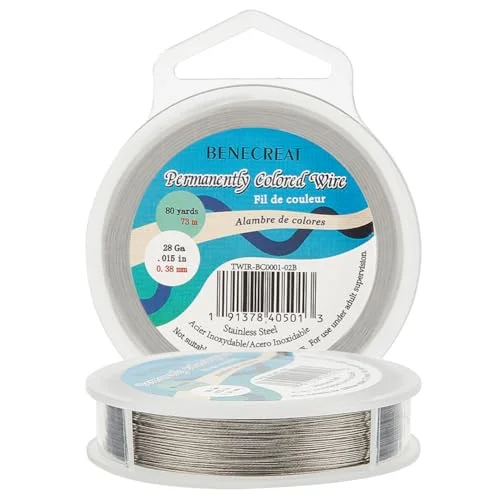
| Budget by the foot | BENECREAT 7-strand, .015 in, 240 ft | Longest spool on this list for the money; fine for practice and crafts | 7-strand only, one diameter, strength is a listing claim, mixed consistency reviews |
What Makers Actually Agree On
The 33 threads disagree about almost nothing on this subject, which is rare.
- Two brands. Beadalon and Soft Flex are named in every thread that names a brand at all. Fire Mountain’s Accu-Flex and The Beadsmith’s Flex-Rite are accepted as equivalents. No-name marketplace spools are the thing makers tell each other to leave behind; one of the most upvoted replies of 2026 on r/Beading put it as “Amazon is a wasteland. You want Fire Mountain Gems.”
- Strand count is feel, diameter is strength. Beadalon’s own words: 7-strand is stiff, cheap, and holds a curve; 19 is the default; 49 “feels almost like thread” with the “highest resistance to kinking and breakage.” Diameter decides break strength and which beads fit.
- 49 for drape and durability. “I always use 49 strand Beadalon, it moves better and looks much more elegant.” “Soft flex is the best on the market. I only use the 49 strand.” “The 49 strand one is the sturdiest and at the same time, very flexible.”
- 7-strand and tigertail kink, and the kink is permanent. Fire Mountain says it plainly: tigertail “is not kink-resistant, so when it kinks, those kinks cannot be worked out.” Makers describe the same upgrade path, tigertail first, then 19 or 49 once a folded necklace came out of a bag ruined.
- Thread is for weaving, cable is for stringing. The two highest-voted answers we found on the subject, both at 14 points: “Fireline is not for strung beads,” and gemstone beads “WILL CUT YOUR CORD.” Crimps go on cable only.
- The wire rarely fails; the finish does. Loose ends after a week are a slipping crimp or a strand strung with no slack, not stretch. Base-metal crimps are the part makers blame most often.
Strand Count: 7, 19, 21, and 49 Explained
Every wire here is the same idea: stainless steel micro-strands twisted together inside a nylon jacket, finished with crimps rather than knots. The number of strands changes how the cable bends.
| Strands | Construction | Feel | Who makes it | Best for |
|---|---|---|---|---|
| 3 to 7 | one twist of 3 or 7 strands (tigertail) | stiff, holds a curve, kinks permanently | Beadalon 7, Soft Flex Econoflex, Fire Mountain Tigertail, BENECREAT | budgets, practice, stiff designs, beaded curtains and crafts |
| 19 | 19 strands twisted | supple, mild kink resistance, “can untwist under heavy strain” | Beadalon 19, Soft Flex Extreme (precious metal) | the everyday default |
| 21 | 21 strands | Soft Flex’s fine-wire construction | Soft Flex Fine, Accu-Flex, Flex-Rite | small-hole beads, pearls |
| 49 | 7 bundles of 7 strands | thread-like drape, best kink resistance | Beadalon 49, Soft Flex Medium and Heavy, Accu-Flex, Flex-Rite | necklaces, anything folded or worn daily |
Beadalon’s engineering note explains the 49 advantage: it is seven bundles of seven strands, so each bundle flexes as a unit and the cable bends in any direction without one strand taking the strain. Fire Mountain reaches the same conclusion from the other side: “To ensure you don’t ruin a beautiful piece simply by folding it, invest in a wire with a higher strand count.”
Break Strength by Brand and Diameter
No manufacturer publishes one table with every strand count and diameter in it, so this one is assembled from each maker’s own pages. Test strength is the pull that snaps the wire, not a load rating; Beadalon’s answer to “is 20 pounds enough” is that “most necklaces don’t weigh anywhere near 20 lbs.”
| Wire | .010 in | .014 or .015 in | .018 or .019 in | .024 in |
|---|---|---|---|---|
| Beadalon 49-strand | 20 lb | 26 lb (FAQ wording) | 40 lb | |
| Beadalon 19-strand | 7 lb | 17 lb | 48 lb, as published | |
| Beadalon 7-strand | 15 lb | 20 lb | 20 lb | |
| Soft Flex (21 and 49) | 5 lb (Soft Touch, 7-strand) | 10 lb (.014, 21-strand) | 26 lb (.019, 49-strand) | 40 lb (49-strand) |
| Soft Flex Econoflex 7-strand | 10 lb | 15 lb | 20 lb | |
| Beadsmith Flex-Rite 49-strand | 24.6 lb, listing claim | |||
| BENECREAT 7-strand | 18 lb, listing claim (0.38 mm) | 19 lb, listing claim (0.46 mm) |
Two things to read off that table. First, diameter moves the number far more than strand count: Beadalon’s 49-strand doubles from 20 to 40 pounds between .015 and .024 inch, while at .015 the gap between 7 and 49 strands is five pounds. Second, Beadalon publishes its 19-strand .024 at 48 pounds, above its own 49-strand at 40; we report it as printed rather than tidy it up.
The only independent numbers we found are old but useful. In 2005 Fire Mountain Gems commissioned OnSpeX, an independent lab, to pull three .024 inch 49-strand wires, all rated 40 pounds. Soft Flex broke at an average of 65.5 pounds, Accu-Flex at 50.9, Beadalon at 49.4, and all three survived 5,000 flex cycles without breaking. Soft Flex also took a permanent kink only at a tighter bend than the other two. The test was paid for by the owner of Accu-Flex, covered one diameter, and is two decades old, so treat it as the one data point it is, not a verdict.
Which Diameter for Which Beads
Beadalon’s first rule against abrasion is the rule every maker repeats: use the largest diameter that passes through the beads’ holes. A loose bead saws at the wire every time the piece moves; a wire that fills the hole does not.
| Beads | Diameter | Crimp bead (Beadalon size) | Crimp tube | Minimum crimp inside diameter, single strand |
|---|---|---|---|---|
| Seed beads 15/0 and 11/0, small pearls | .010 to .013 in (0.25 to 0.33 mm) | 0 or 1 | 1 | about 0.5 to 0.7 mm |
| 2 mm gemstone rounds, pearls | .014 or .015 in (0.36 to 0.38 mm) | 1 | 2 | 0.76 mm |
| 3 to 4 mm crystals | .018 in (0.46 mm), or .024 if the holes allow | 1 | 2 | about 0.9 mm |
| 6 to 8 mm glass and stone rounds | .018 or .019 in | 1 | 2 | 0.9 to 0.97 mm |
| Heavy stone, lampwork, bracelets | .024 in (0.61 mm) | 2 or 3 | 2 or 3 | 1.22 mm |
| Very heavy or long strands | .030 to .036 in | 3 | 4 | 1.5 mm and up |
Crimp sizes are from Beadalon’s crimping chart, inside diameters from Fire Mountain’s crimp chart; double the inside diameter if you run the wire back through the crimp twice. Soft Flex’s guidance is simpler and agrees: 1 by 1 mm crimps for .010, 2 by 2 mm for .014 and .019, 2 by 3 mm for .024. Our guide to crimp beads, crimp tubes, and clamshell bead tips walks through closing each of them.
One maker’s outcome is worth more than the chart for the smallest beads: after asking which wire fits 2 mm gemstones, they strung them on Soft Flex .014 Fine, called it “perfect,” and reported the .019 Medium “would be too thick for the small 2 mm bead holes.”
The Picks, in Detail
1. Most necklaces and bracelets: Beadalon 49-strand, .018 inch
This is the spool the threads keep coming back to. Beadalon’s 49-strand .018 inch wire, 30 feet in the bright stainless finish, is the all-around size the company itself recommends, the one maker after maker names for drape (“it moves better and looks much more elegant”), and the one a bead-store veteran guaranteed would not break on a customer whose necklaces kept snapping. It is made in Pennsylvania, the label prints the crimp size to use, and the line runs seven diameters from .013 to .036 inch in ten colors, so the same wire scales from pearls to heavy stone.

The limits are price and one recent grumble. Forty-nine strands cost more per foot than 19, and for a production run the 100-foot spool is the better buy. In July 2026 one maker reported that a fresh spool of the .013 size felt stiffer than spools bought months earlier and would hold a kink; another regular user had not noticed a change. We mention it because it was said, not because we could confirm it.
2. Softest drape and the best lab numbers: Soft Flex 49-strand .019 Medium
If Beadalon is the wire makers default to, Soft Flex is the wire they defend. “Soft flex is the best on the market. I only use the 49 strand regardless of color,” wrote one, after “too many kinks bends and overall fails with the cheaper brands.” Soft Flex .019 Medium is the company’s all-purpose size, 49 strands of marine-grade stainless in a nylon jacket, rated 26 pounds, lead-free, made in the USA, and supple enough that the company says it can be knotted. It was also the wire that broke last in the OnSpeX test, at 65.5 pounds against a 40-pound rating.

Two honest limits. Soft Flex sells only three diameters in the original line, .014, .019, and .024, so there is no .010 for seed beads outside the Soft Touch range and no .030 for the heaviest strands. And the 30-foot spool drifts in and out of stock on Amazon; the 100-foot spool linked above is the one that stays available, which suits anyone who has already decided this is their wire.
3. The value default: Beadalon 19-strand, .018 inch
Beadalon calls its 19-strand “the perfect combination of strength, flexibility, and price,” and an independent shop guide says the same thing to beginners: “start with the middle grade, 19 strand wire.” Beadalon 19-strand .018 inch, 30 feet, is that middle grade at the all-around diameter, with a 100-foot spool for volume. The crimp pairing is the same size 1 bead or size 2 tube as the 49-strand, so nothing else in your kit changes.
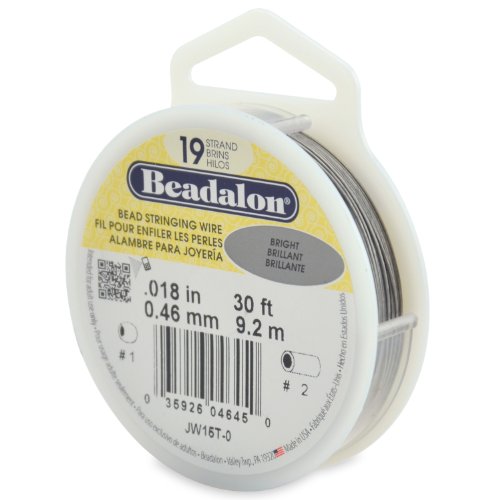
What you give up is drape and forgiveness. Nineteen strands kink more readily than 49, Beadalon’s own FAQ notes the construction “can untwist under heavy strain,” and one maker found light beads on it “look all uneven” until they moved to a thin 49-strand. For a necklace that will be folded into a travel bag, spend the difference.
4. Pearls and 2 mm beads: Soft Flex 21-strand .014 Fine
Small holes are where most wire advice falls apart, because the all-around .018 will not go through a 2 mm gemstone or a small freshwater pearl. Soft Flex .014 Fine is the answer the threads arrived at by trial: 21 strands, 0.36 mm across, rated 10 pounds, which Soft Flex describes as “ideal for soft materials, seed beads and fresh water pearls.” Pair it with 2 by 2 mm crimps and a Micro or Standard crimping tool.
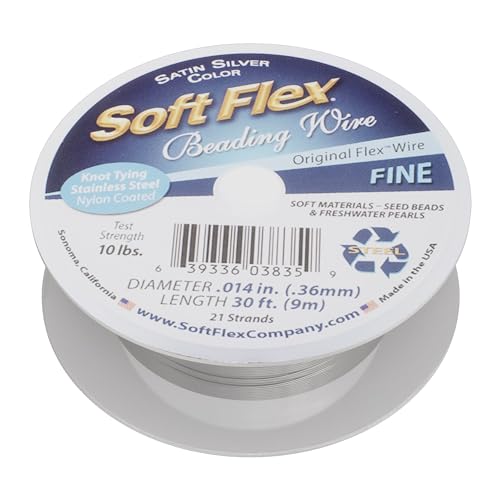
Ten pounds is plenty for pearls and light stone and wrong for anything heavy; a strand of 8 mm jasper belongs on the Medium or Heavy. And 21 strands, while soft, is not the 49-strand drape of the two picks above, so this is a fit-the-hole choice, not a feel choice.
5. Runner-up 49-strand: Beadsmith Flex-Rite, .018 inch
The Beadsmith’s Flex-Rite is the third 49-strand name makers accept without argument, and the .018 inch clear spool is a direct alternative to the Beadalon pick, with a clear rather than bright coating that disappears behind glass and crystal. The line runs 7, 21, and 49 strands and the Beadsmith describes the 49 as its professional grade.

The break strength of 24.6 pounds appears only on retail listings, not on a manufacturer chart, so we list it as a claim. And the 49-strand construction here has not been independently tested the way the three wires in the OnSpeX report were. It is a good wire with thinner paperwork.
6. Stiff designs and a branded budget: Beadalon 7-strand, .015 inch
Every search we ran on Amazon’s beading-wire category returned the same best seller: Beadalon’s 7-strand .015 inch. It is the cheapest Beadalon by a wide margin, it “will hold its shape well,” and Beadalon suggests it for “heavier beads where stiffness helps,” meaning wood, ceramic, and large stones, and for anyone learning to crimp who will waste a lot of wire. Rated 15 pounds at this size and 20 at .018.

The case against it is the drape. Seven strands kink, the kink stays, and one shop guide goes as far as saying 7-strand “cheapens the design” of a necklace or bracelet. Makers who buy it as a beginner wire tend to move up within a few projects, which is the honest way to use it.
7. Budget by the foot: BENECREAT 7-strand, .015 inch, 240 feet
Our spool is the tigertail-class budget wire on this list, and that is the frame it deserves. BENECREAT’s 7-strand .015 inch wire is 240 feet of nylon-coated 304 stainless, 0.38 mm across, on one spool, which makes it the longest reel here by a distance and the right buy for crimp practice, kids’ bracelets, suncatchers, beaded curtains, and strung pieces that will not be folded. It fits the same size 1 crimp beads and size 2 tubes as the Beadalon .015. A kit version adds jump rings, crimp beads, and clasps for someone starting from nothing.

The cons are the ones a reader should hear from us first. It is 7-strand only; there is no 19- or 49-strand BENECREAT wire, so nothing in our line competes with the top of this list. The strength figures on the listing, 18 pounds for this diameter, are the seller’s numbers, not a lab’s. And reviews are mixed on consistency: buyers praise the price and say it is easy to work with and knot, while a review summary posted on Reddit for the 300-foot sibling spool lists “inconsistent wire strand count” and “misleading gauge size” among the complaints. For a first necklace you plan to wear every day, buy the Beadalon or Soft Flex above and keep ours for the bench.
When Beading Wire Is the Wrong Material
Two other stringing materials come up in every thread, and both are for different jobs.
Bead weaving thread. Fireline and Beadalon Wildfire are bonded threads, 6 to 12 pound test, made for weaving stitches where the thread passes through each bead several times. They are not crimped and they do not survive a strung strand of stone or glass; the makers who tried it restrung the same bracelet three times before someone told them why. If a pattern says peyote, herringbone, or right-angle weave, buy thread. If it says crimp, buy cable.
Stretch cord. Elastic is a convenience for stacking bracelets and wears through on sharp holes; our best stretch cord for bracelets guide covers the sizes and the surgeon’s knot. Any bracelet of faceted crystal or dense stone belongs on 49-strand cable with a clasp instead.
Finishing: Where Strung Pieces Actually Fail
The threads about broken necklaces almost never end with a broken wire. They end with a crimp. Three rules cover nearly every case.
- Match the crimp to the diameter using the table above. A crimp that is too big cannot bite the wire and slides; Beadalon warns that flattening a crimp with flat-nose pliers leaves a sharp edge that cuts the wire, so use crimping pliers.
- Use sterling or plated crimps, not base metal. The most repeated single warning in the corpus.
- Leave slack and tug-test. Beads take more room in a circle than in a line, so a strand strung tight will show gaps after a week. After closing a crimp, pull on it hard; if it moves, redo it.
Wire guardians and crimp covers are the finishing touches makers add for pieces they sell, and both are covered in the crimp guide. For the pliers themselves, see the tools a beginner actually needs.
Where BENECREAT Stands in This List
Seventh of seven, and honestly so. We make a 7-strand budget wire in one diameter, and the market’s answer for a wearable necklace is a 19- or 49-strand wire from Beadalon or Soft Flex. Our spool earns its place as the cheapest way to learn crimping and to string things that do not need to drape, and it loses to every wire above it on feel and paperwork. We would rather you know that before you string a gift on it.
A First Shopping List
- One 30-foot spool of Beadalon 49-strand .018 or Soft Flex .019 Medium for the pieces you will wear
- One spool of Soft Flex .014 Fine the first time a pearl or 2 mm bead refuses the .018
- A 240-foot budget spool for practice, so mistakes cost nothing
- Size 2 crimp tubes, crimping pliers, and wire guardians, sized from the table above
- Beading thread only when a pattern calls for weaving
Everything strung ends up in a box eventually; our guide to organizing beads and gemstones covers storing finished strands without kinking them, and the beading supplies range holds the wire and findings we do make.
Sources
- Beadalon, 5 Rules for Defeating Abrasion (break-strength table), FAQ, FAQ archive 1 and archive 2, and the 49-strand, 19-strand, and 7-strand product pages
- Beadalon’s strand guide posted on r/jewelrymaking
- Soft Flex Company, Beading Wire Comparison Chart and Soft Flex vs Soft Touch diameters
- Fire Mountain Gems, independent OnSpeX flex-wire test, Know Your Beading Wire, Ask the Experts on tigertail, and the crimp inside-diameter chart
- Rio Grande product pages for Beadalon 49-strand and Soft Flex 49-strand test strengths and country of origin
- Reddit threads, 33 in total from r/Beading, r/jewelrymaking, and r/braceletcraft, 2018 to 2026, including wire keeps breaking, Beading wire or Fireline?, Unsure about best string/wire to use, and wire stretching over time?
- Shop guides consulted for the consensus: CJ Beaders, Eureka Crystal Beads, Tejas Beads, and Perles & Co
Reviewed by the BENECREAT Craft Team.
Frequently Asked Questions
Which is better, Beadalon or Soft Flex beading wire?
Both are the two names makers give in every thread we read, and either 49-strand line will outlast a cheap spool. Beadalon publishes a fuller size range (seven diameters in 49-strand, ten colors) and its .018 inch spool is the all-around size most shops stock. Soft Flex sells only three diameters, but its .019 Medium posted the best numbers in the only independent lab test we found and it is supple enough to knot. Pick Beadalon for sizes and colors, Soft Flex for the softest drape.
What is the difference between 7, 19, and 49 strand beading wire?
Strand count sets flexibility and price, not strength. All three are stainless steel micro-strands twisted inside a nylon coating; 49-strand is seven bundles of seven, which is why it drapes like thread and resists kinks. Seven-strand is stiffer, holds a curve, and costs the least. Nineteen is the middle ground and the usual default. Diameter, not strand count, decides how much weight the wire takes and which beads it fits.
What size crimp do I use with Beadalon 19-strand .018 wire?
Beadalon's own chart pairs every diameter from .015 to .021 inch with a size 1 crimp bead or a size 2 crimp tube, closed with the standard crimping tool. That applies to 19-strand and 49-strand alike, since crimp size follows diameter. Fire Mountain's chart gives the same answer in millimeters: a single strand of .018 inch wire needs a crimp with an inside diameter of at least about 0.9 mm, and a doubled strand needs roughly twice that.
Does beading wire stretch?
No. Beadalon's answer is that its stainless strands do not stretch, and the gaps that appear at the ends of a necklace after a few wears come from two other causes. Either the beads were strung with no slack, so they take more room in a circle than in a straight line and pull the wire taut, or the crimp is slipping. Tug the crimp; if it moves, the finish failed, not the wire.
Can you knot beading wire instead of crimping it?
The soft 49-strand lines can be knotted; Soft Flex says so on its product pages and makers use knots to finish it. It is still not the normal finish, because a knot in nylon-coated cable is bulky and can loosen, while a correctly sized crimp tube closed with crimping pliers holds far better. Tigertail-class 7-strand wire kinks at the knot and is always crimped.
What diameter beading wire for 2 mm, 6 mm, and 8 mm beads?
Use the thickest wire that passes through the hole freely. For 2 mm gemstone rounds and small pearls that is .014 inch, the Fine size, and makers report the .019 Medium will not fit. For 6 to 8 mm glass and stone rounds, .018 or .019 inch is the all-around answer; Beadalon suggests .018 or .024 for 3 and 4 mm crystals because crystal holes cut. For heavy or abrasive stones and bracelets, go to .024 inch.
Is tigertail the same as beading wire?
It is the oldest and simplest kind: three or seven stainless strands twisted and coated with nylon. It is cheap and strong enough for many pieces, but it has almost no kink resistance, and a kink cannot be worked out. Every maker thread we read describes the same upgrade path, from tigertail to a 19- or 49-strand wire from Beadalon or Soft Flex once a finished necklace has been folded once and ruined.
Can I string a bracelet on Fireline instead of beading wire?
Not with gemstones or glass, and not with crimps. Fireline and Wildfire are bonded threads made for bead weaving, where the thread passes through beads many times. Strung stone beads saw through them, and crimps cut them; the highest-voted answers on r/Beading say exactly that after seeing bracelets restrung three times. Use nylon-coated beading wire with crimp tubes for strung pieces and keep thread for weaving.
The by-the-foot spool for practice and volume
BENECREAT 7-strand nylon-coated stainless beading wire, 0.015 inch, 240 feet on one spool: the tigertail-class budget wire for learning crimps, kids' crafts, and strung pieces that do not have to drape.
See the 240-foot spool